Table of Contents
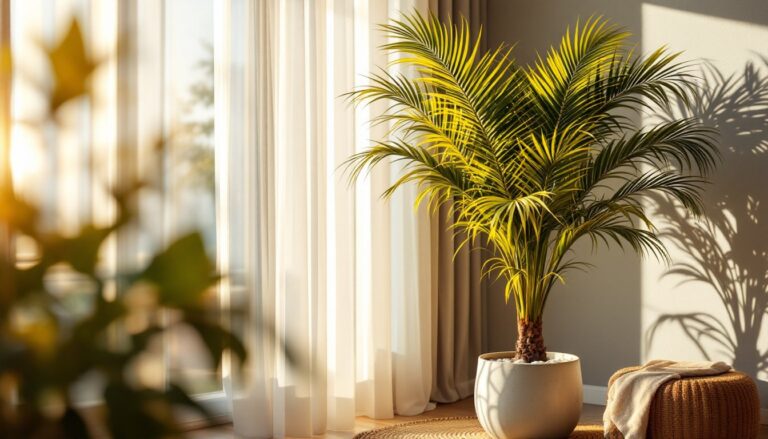
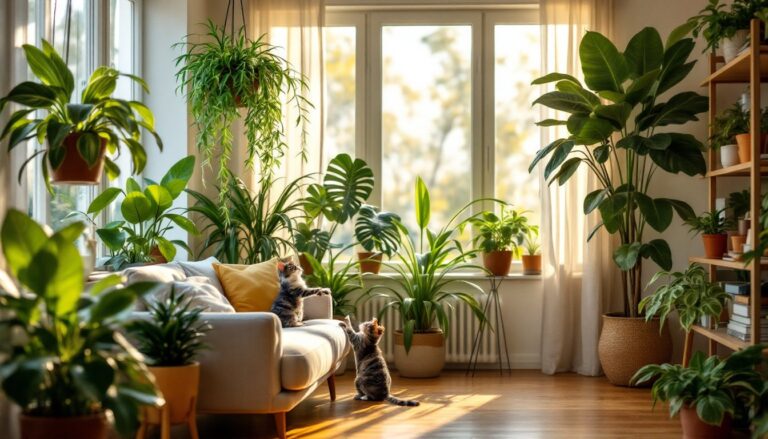
ToggleYou’ve brought home a leafy green friend from the garden center, but the tag fell off somewhere between the checkout and your car. Now you’re standing in your living room wondering: what exactly is this thing, and what does it need? Plant identification isn’t about memorizing Latin names or becoming a botanist overnight. It’s about learning to read the clues your plant is already showing you, the shape of its leaves, how it grows, and the unique features that make it recognizable. Whether you’re managing a small collection or building a full indoor jungle, knowing how to identify common house plants helps you provide the right care and troubleshoot problems faster. Let’s walk through the practical methods that’ll turn you into a confident plant parent.
Key Takeaways
- Leaf shape, texture, and arrangement are the strongest clues for identifying common house plants, allowing you to narrow down possibilities in just 30 seconds of observation.
- Knowing how to identify house plants helps you match them to the correct light conditions, watering schedules, and humidity levels, preventing misdiagnosis of plant problems.
- Growth patterns, stem characteristics, and size reveal whether a plant is a climber, trailing vine, or compact bushy variety, helping you understand its natural behavior and care requirements.
- Distinctive features like fenestrations in Monsteras, bold patterns in Calathea, and sword-like leaves in Snake Plants make identification nearly instant once you learn what to look for.
- Joining plant communities, accessing care resources, and swapping cuttings with other growers becomes possible once you’ve successfully identified your plants with confidence.
Why Plant Identification Matters For Home Gardeners
Before you start playing detective with your plants, it’s worth understanding why identification actually matters. When you know what you’re growing, you can match it to the right light conditions, watering schedule, and humidity level. A plant struggling in the wrong spot often looks sick, but the problem isn’t disease, it’s location. You can’t guess whether a plant wants bright indirect light or low-light tolerance without knowing its species or family.
Identification also saves you money and frustration. If you can name what you’re growing, you can research its specific needs instead of applying generic “water when dry” advice that might be perfect for a succulent but deadly for a Calathea. Plus, when you find a plant thriving in your neighbor’s kitchen, you can ask what it is and duplicate that success in your own home.
Finally, identification connects you to the plant community. Once you know you’re growing a Monstera deliciosa, you can join online forums, find care videos, and swap cuttings with other growers. It transforms houseplants from random green things to actual companions you understand and can discuss with confidence.
Leaf Shape And Texture: Your First Identification Tool
Leaf shape is your strongest clue. Spend 30 seconds looking at the outline of a single leaf, not the whole plant, just one leaf. Is it elongated and narrow? Round and small? Deeply lobed like an oak? Deeply split like a Monstera? These characteristics narrow down possibilities dramatically.
Texture matters too. Run your finger across the leaf surface (gently). Some plants have smooth, glossy leaves (like a Rubber Plant), while others feel velvety or fuzzy (like African Violet or Begonia varieties). Some leaves are ribbed or have prominent veining that you can feel as well as see. Philodendrons often have heart-shaped leaves, while Pothos look similar but with a slightly different shape and smoother texture.
Leaf arrangement is another quick filter. Are leaves opposite each other up the stem, or do they alternate? Are they clustered at the top or spread along the whole stem? Some plants like Syngonium have arrow-shaped leaves, while Calathea varieties often display oval or elongated leaves with bold patterns.
Color and patterns help too. Look for variegation (white, yellow, or pink sections), spots, stripes, or solid colors. A Pothos marble queen has cream-colored variegation, while a Monstera deliciosa typically shows solid green with characteristic holes. Many beautiful house plants exhibit distinctive coloring that makes identification almost instant once you know what to look for.
Plant Size, Growth Pattern, And Stems
How a plant grows tells you a lot. Is it a climber? A trailing vine that cascades from a shelf? A compact bushy plant? A tall, upright grower? Growth habit is often tied to the plant’s natural environment. Pothos and Philodendron varieties naturally climb trees in the wild, so they’re natural climbers indoors. Succulents tend to grow low and compact, storing water in thick leaves. Vining plants like these are perfect candidates if you’re building viney house plants collections.
Examine the stem closely. Is it thin and delicate, or thick and woody? Do the leaves sit directly on the stem, or are there visible petioles (the little stalks connecting leaf to stem)? Some plants have fuzzy or hairy stems, others are smooth or have a waxy coating. African Violets have very short petioles and thick, fuzzy stems, while Pothos has longer petioles and smoother stems.
Size also hints at the plant’s identity and maturity. A young plant might look completely different from a mature specimen of the same species. Monsteras develop those famous splits only as they mature. New leaves on many tropical plants unfurl differently than established ones. If you’re comparing your plant to photos online, remember you might be looking at a much older, bigger version of what you own. Consider whether your plant is a young seedling or a more established specimen when making comparisons.
Flowers, Colors, And Distinctive Features
Flowers are the ultimate identification tool if your plant is currently blooming. Even if you’re not into flowering houseplants, many common ones bloom indoors under the right conditions. African Violets have clustered purple, pink, or white flowers. Begonias produce waxy blooms in various colors. Orchids have instantly recognizable exotic flowers.
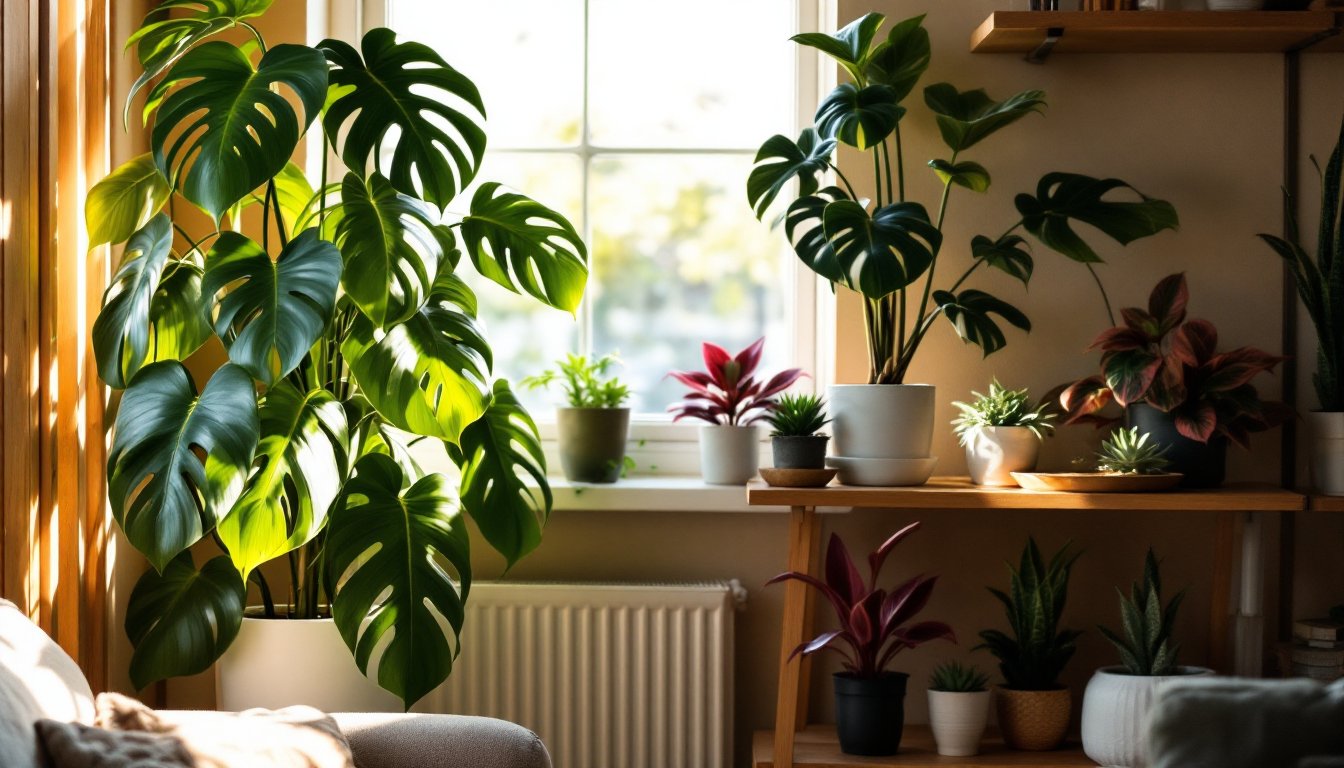
If there’s no bloom, look for distinctive features unique to certain plants. Monsteras have their signature fenestrations (holes in mature leaves). Calathea varieties often have boldly patterned leaves with colors like deep pink, burgundy, or cream. Snake Plants (Sansevieria) have tall, stiff, variegated leaves that grow almost vertically. ZZ Plants have glossy, oval leaflets arranged in pairs along a central stem.
Color patterns are huge. Syngoniums often display pink, red, or white variegation. Dieffenbachia varieties have large leaves with cream or white patches. Croton leaves come in shades of red, orange, and yellow alongside green. Some plants like Calathea orbifolia have stunning white stripes on green leaves that are almost impossible to mistake.
Resources like The Spruce and Better Homes & Gardens include detailed plant profiles with flowering photos, color variations, and distinctive features side-by-side. If your plant matches the leaf shape, growth pattern, and distinctive visual features you see there, you’ve likely found your match.
The Most Common House Plants You’ll Encounter
Tropical Favorites And Low-Light Champions
Let’s identify some plants you’ll actually find in homes. Pothos (also called Devil’s Ivy) is possibly the most common houseplant. Heart-shaped leaves, often with some variegation, smooth waxy texture, naturally climbing or trailing. It tolerates low light better than almost anything.
Philodendron varieties come in several forms. Heartleaf Philodendron looks very similar to Pothos but with slightly less waxy leaves. Philodendron Brasil has green leaves with yellow or cream variegation. Larger types like Philodendron Selloum (also called Xanadu) have deeply split leaves.
Monstera deliciosa is unmistakable once mature: large, split leaves with fenestrations. Young plants look like simple green hearts, so people often misidentify them. Syngonium podophyllum starts with arrow-shaped leaves and often displays pink or red variegation. It trails naturally but can also climb.
Calathea varieties are prized for patterned leaves. Look for distinctive leaf patterns, stripes, spots, or colorful edges. They often have reddish undersides. ZZ Plants have glossy, dark green leaflets arranged neatly along stems. They’re nearly indestructible in low light. Snake Plants (Sansevieria trifasciata) have tall, stiff, sword-like variegated leaves and tolerate extreme neglect.
Succulents And Easy-Care Indoor Plants
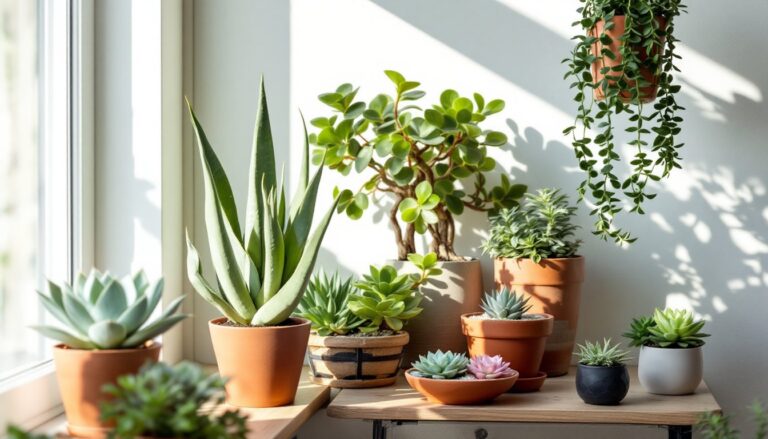
Common succulent house plants include Jade Plants, which have thick, fleshy leaves arranged oppositely on woody stems, often with a reddish tinge on new growth. Aloe vera has tall rosettes of thick, fleshy leaves with a grayish-green color and marginal teeth. Echeveria varieties form tight rosettes with powdery-looking leaves in shades of blue, pink, or purple.
Jade (also called Crassula ovata) is woody and tree-like, easily recognizable by its thick, smooth leaves. String of Pearls (Senecio rowleyanus) has delicate trailing stems dotted with small spherical leaves. Haworthia resembles small Aloe but stays compact with dense rosettes of thin, geometric leaves.
For those wanting tropical energy without fussiness, consider types of cactus house plants. Spine cacti have obvious spines and segmented or globular bodies. Christmas cactus looks nothing like typical cacti, it has flat, soft stems with small notches along the edges and produces pink or red flowers. Easter cactus is similar but with rounded segment edges.
Peperomia plants are compact and bushy with small, thick leaves in red, green, or variegated patterns. Prayer Plants (Maranta) have oval leaves with intricate patterns, and their leaves fold at night (hence the name). All of these represent some of the most common house plants you’ll encounter in homes, and learning their distinguishing features gives you a foundation for identifying dozens of other species using the same observation methods.
Once you’ve identified your plant, you can care for it properly and watch it thrive. Start with what’s right in front of you, leaf shape, growth pattern, and distinctive features are your map.